
Background
In September 2005 the European Parliament and the Council adopted Directive 2005/35/EC (since amended by Directive 2009/123/EC) on ship-source pollution and on the introduction of penalties, including criminal penalties, for pollution offences. The Directive tasks EMSA to "work with the member states in developing technical solutions and providing technical assistance in actions such as tracing discharges by satellite monitoring and surveillance.
To comply with this task, EMSA developed CleanSeaNet, an integrated service in national and regional pollution response chains, which aims to strengthen operational responses to accidental and deliberate discharges from ships, and to assist participating States to locate and identify polluters in areas under their jurisdiction. The service has been operational since April 2007.
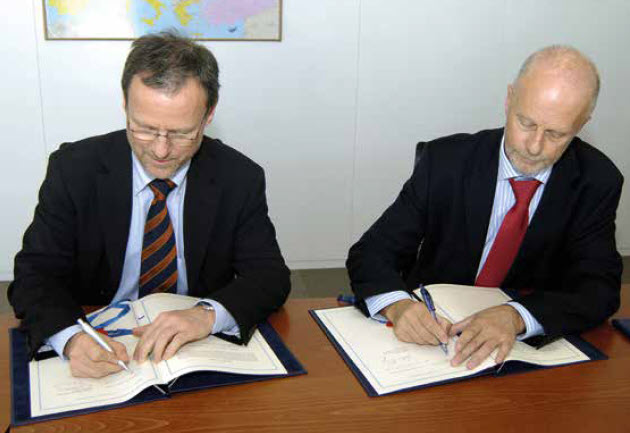 Volker Liebig and Willem de Rulter sign first agreement between EMSA and ESA, Lisbon (2007)
Related Documents
- CleanSeaNet - Detections and Feedback data (2015-2022)
- CleanSeaNet Services Catalogue (2023)
- Earth Observation services infosheet - Supporting Rescue Coordination Centres
- CleanSeaNet - European satellite based oil spill monitoring and vessel detection service
- Copernicus Maritime Surveillance - Product Catalogue
- CleanSeaNet Service - Detecting Marine Pollution from Space
- Copernicus Maritime Surveillance - Info sheets
- Copernicus Maritime Surveillance - Service Overview
- Automatic Detection and Alert Triggering of Ship Behaviour [leaflet]
- Celebrating the CleanSeaNet Service. A ten year anniversary publication
- Integrated Maritime Policy and the SafeSeaNet Ecosystem
- The CleanSeaNet service
- Addressing Illegal Discharges in the Marine Environment
- Integrated Maritime Service Brochure
- CleanSeaNet First Generation Report
- Using satellites to improve maritime safety and combat marine pollution [leaflet]
- EMSA view on the GMES programme of EU and ESA
- CleanSeaNet [2007 leaflet]